YouTube videos actually understood.
Paste a link and get a structured article with chapters, screenshots and key points, right on your Mac. Your first 3 summaries are free and need no API key, and after that Klaara costs €19 once.
Free demos
This is what you get.
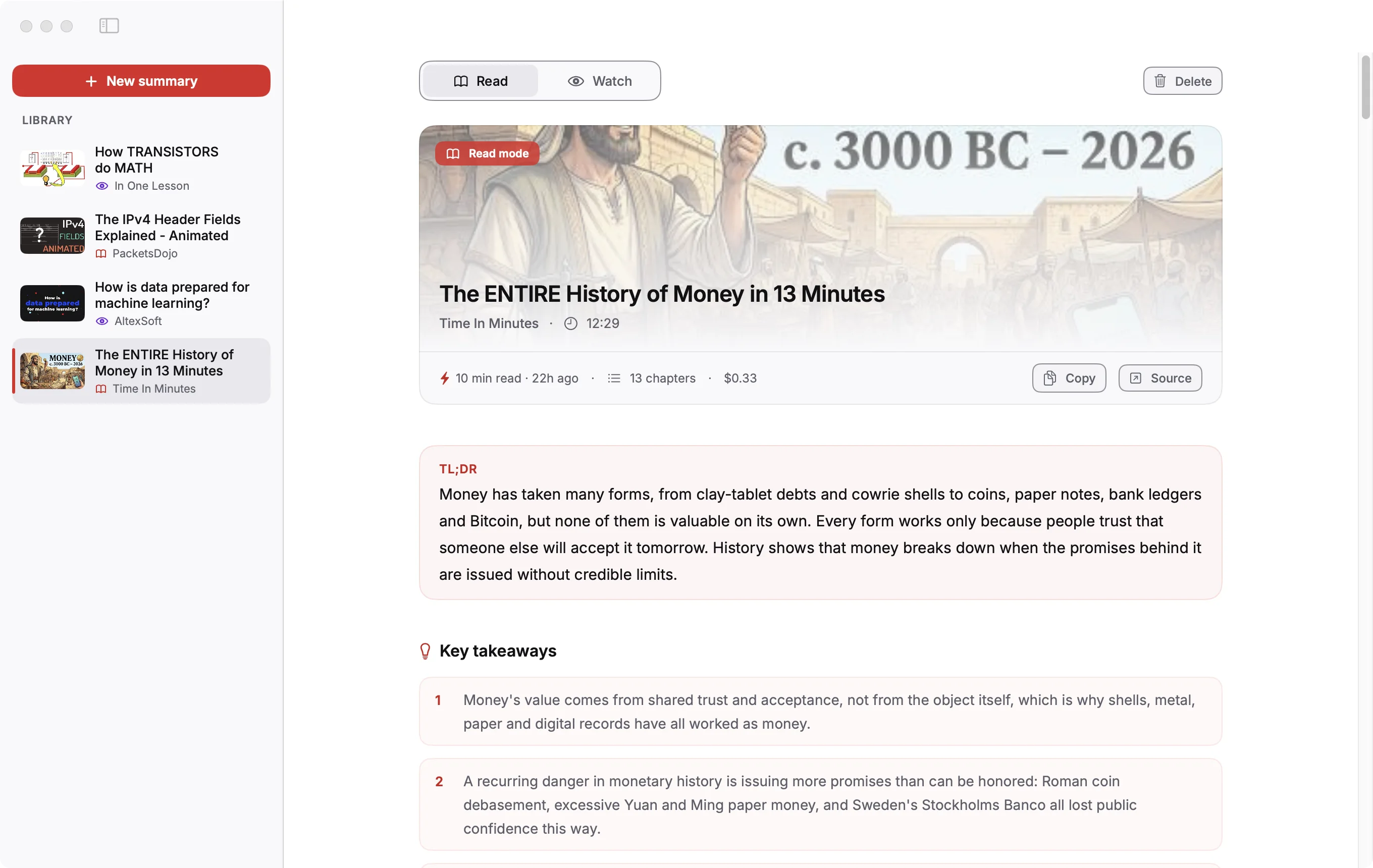
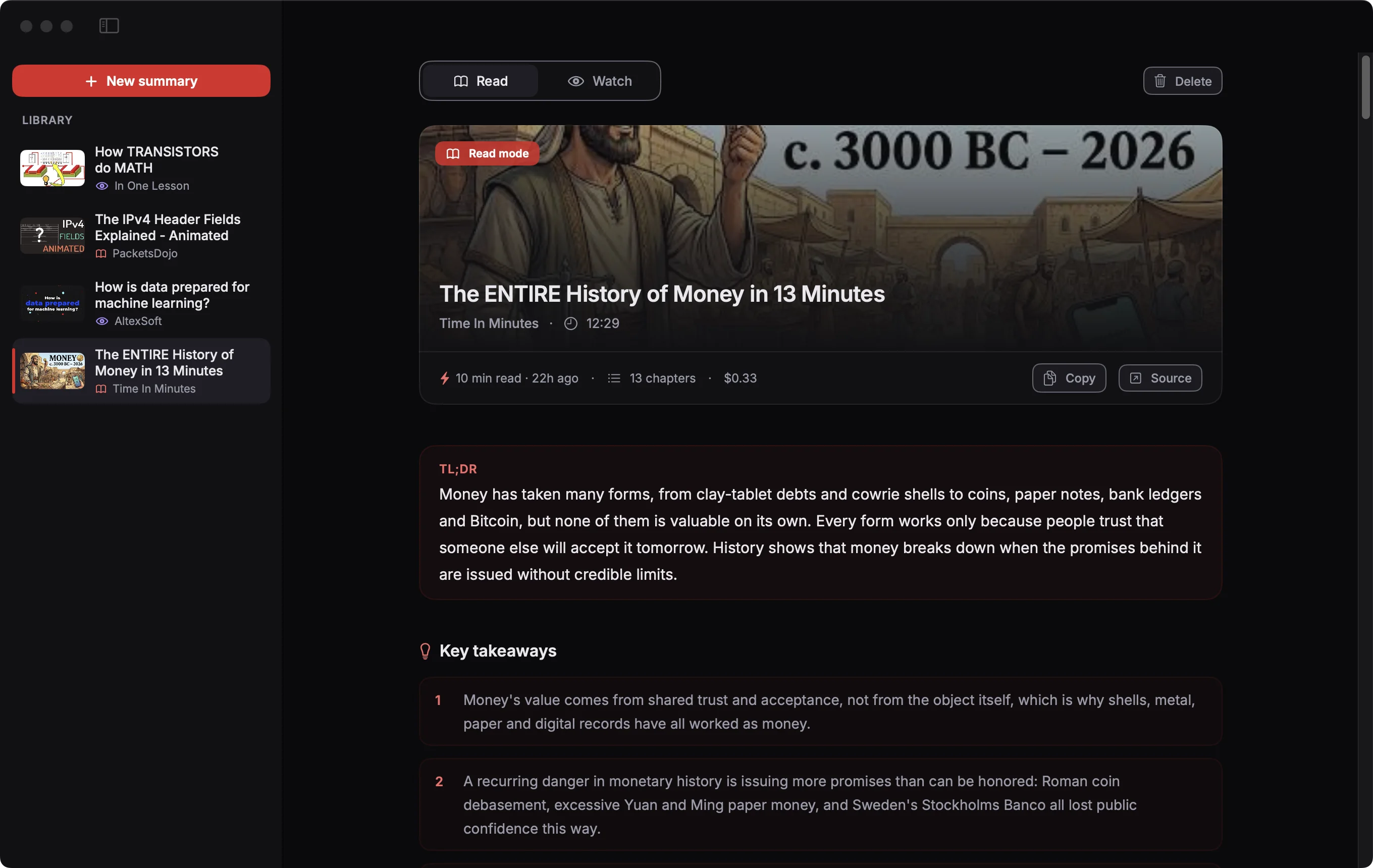
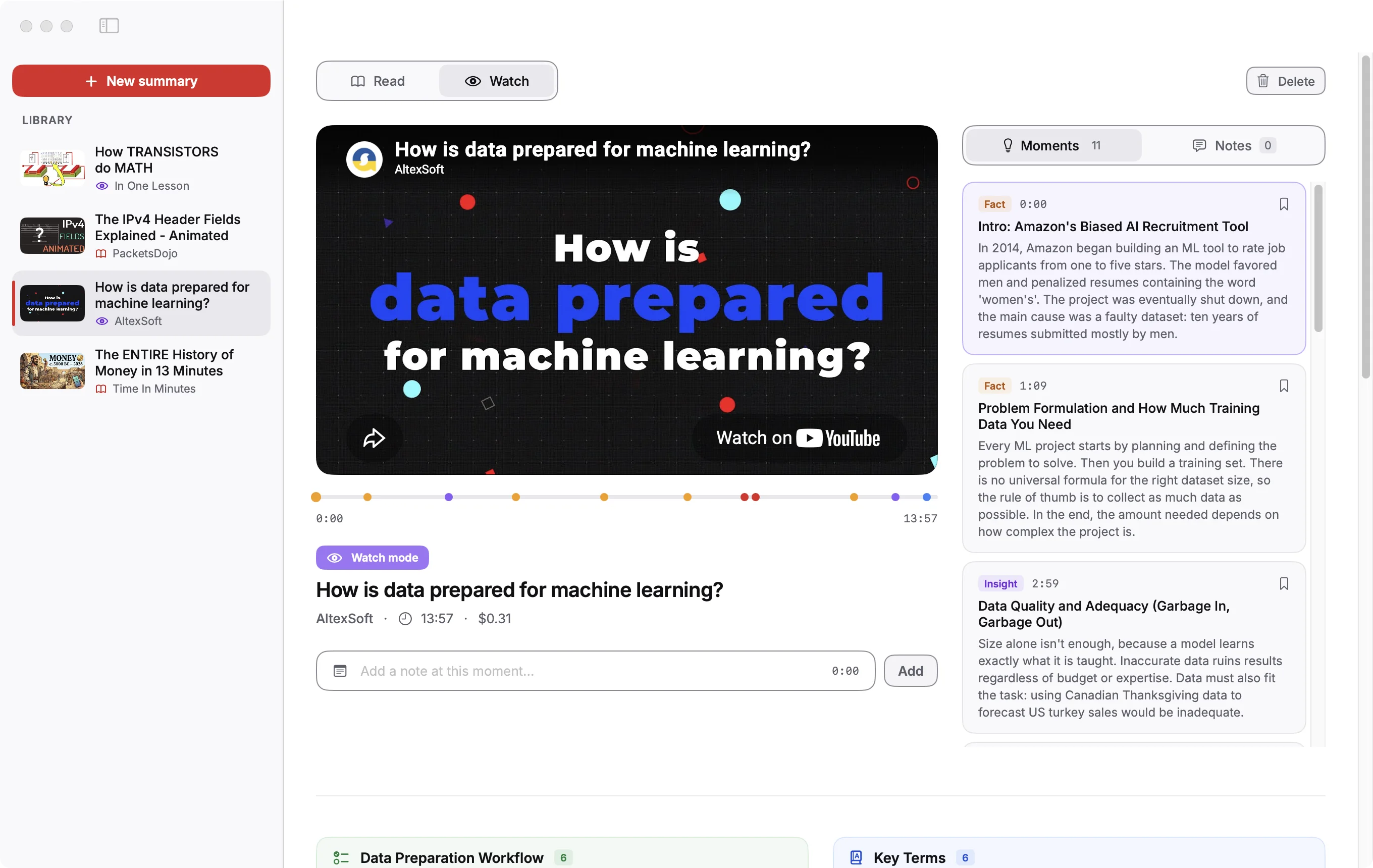
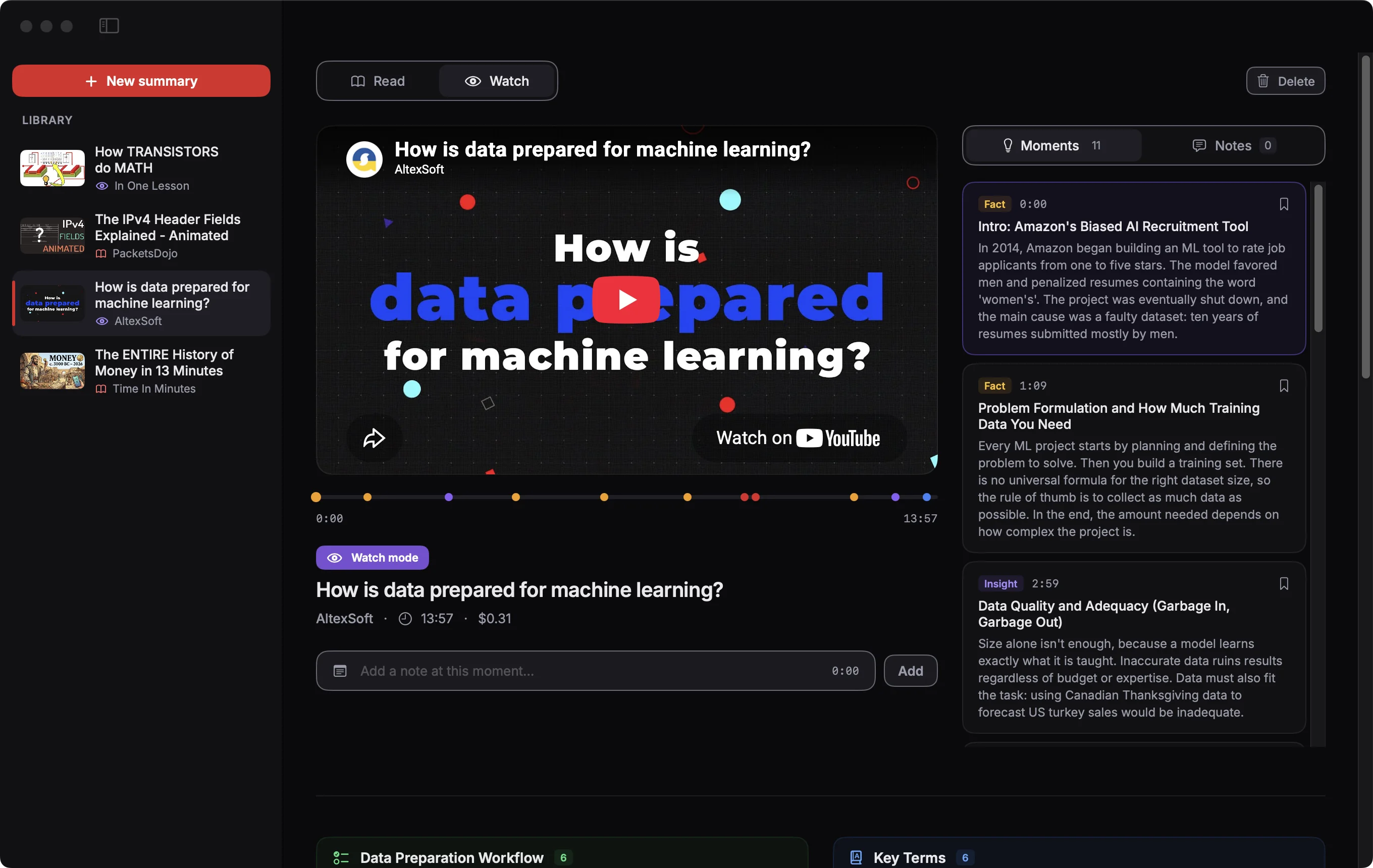
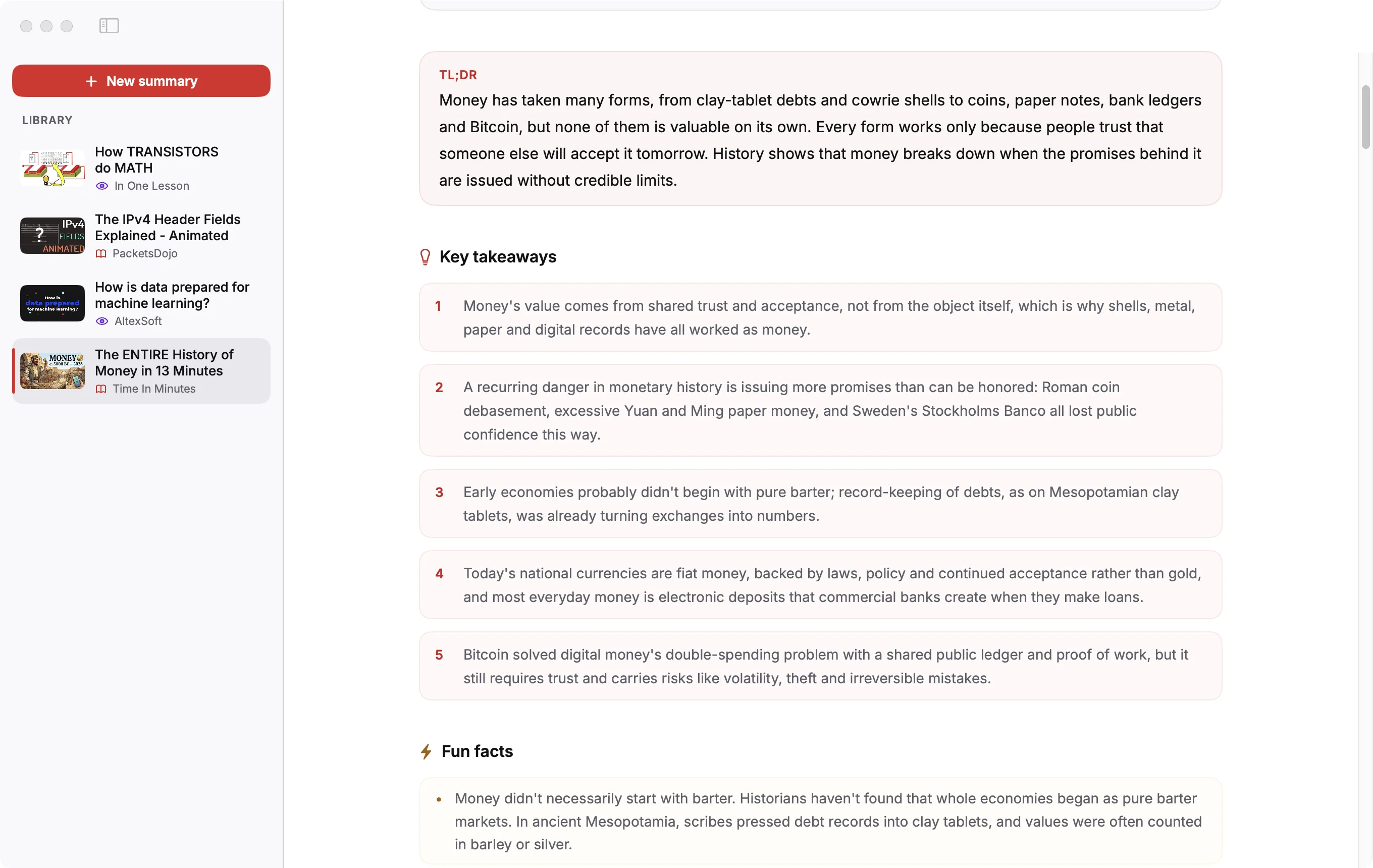
Screenshots of four results in the Mac app, made with Claude Opus 5.5 and left unedited. Pick a video.
Read the whole result as text
The ENTIRE History of Money in 13 Minutes
Time In Minutes · 12:29
TL;DR
Money has taken many forms, from clay-tablet debts and cowrie shells to coins, paper notes, bank ledgers and Bitcoin, but none of them is valuable on its own. Every form works only because people trust that someone else will accept it tomorrow. History shows that money breaks down when the promises behind it are issued without credible limits.
Key takeaways
Money's value comes from shared trust and acceptance, not from the object itself, which is why shells, metal, paper and digital records have all worked as money.
A recurring danger in monetary history is issuing more promises than can be honored: Roman coin debasement, excessive Yuan and Ming paper money, and Sweden's Stockholms Banco all lost public confidence this way.
Early economies probably didn't begin with pure barter; record-keeping of debts, as on Mesopotamian clay tablets, was already turning exchanges into numbers.
Today's national currencies are fiat money, backed by laws, policy and continued acceptance rather than gold, and most everyday money is electronic deposits that commercial banks create when they make loans.
Bitcoin solved digital money's double-spending problem with a shared public ledger and proof of work, but it still requires trust and carries risks like volatility, theft and irreversible mistakes.
Fun facts
- Money didn't necessarily start with barter. Historians haven't found that whole economies began as pure barter markets. In ancient Mesopotamia, scribes pressed debt records into clay tablets, and values were often counted in barley or silver.
- The first coins appeared around the 7th century BCE in Lydia, in what is now Turkey. They were made of electrum, a natural mix of gold and silver, and were stamped to show they met a recognized weight standard. You can think of it as early branding.
- Paper money began in medieval China. Around the turn of the 11th century, merchants in Sichuan issued Jiaozi notes so people didn't have to haul heavy strings of coins, and the Song state later took over the system.
- Sweden's Stockholms Banco issued some of Europe's first banknotes in 1661, partly because Sweden's copper plate money was enormously heavy. The bank then issued more notes than it could honor and failed.
- Most everyday money today exists as bank records rather than physical cash, and commercial banks can create new deposit money when they make loans. The video argues that every form of money, from shells to Bitcoin, depends on trust that others will accept it tomorrow.
Read the video
Chapter-by-chapter breakdown
Introduction: Money as a Question of Trust
The video frames money's history not as a story of shiny objects but as a long answer to one question: why should anyone trust this? Money has been shells, metals, coins, paper, ledger entries and computer records, and it works because people expect others to accept it.
- None of money's historical forms needs to be very useful on its own.
- Paying with a number on a screen would once have seemed like magic.
Beyond the Barter Myth: Mesopotamian Debts and Clay Ledgers
Historians haven't established that whole economies began as pure barter. Communities shared resources and tracked obligations instead. In Mesopotamia, temples and palaces managed grain, land payments and loans, and scribes recorded debts on clay tablets.
- Values were often reckoned in barley.
- Silver served both as a measure of worth and as a means of payment.
- Money was already turning messy exchanges into numbers people could discuss.
Cowrie Shells and Weighed Metal as Early Money
Different societies used different forms of money. Portable cowrie shells circulated in parts of Africa and Asia, and their value depended on who accepted them and how easily new shells arrived. Measured metal was durable and divisible, but buyers had to verify its weight and purity.
- Metal held enough value to travel without carting grain.
- A trustworthy weight and purity test made trading much easier.
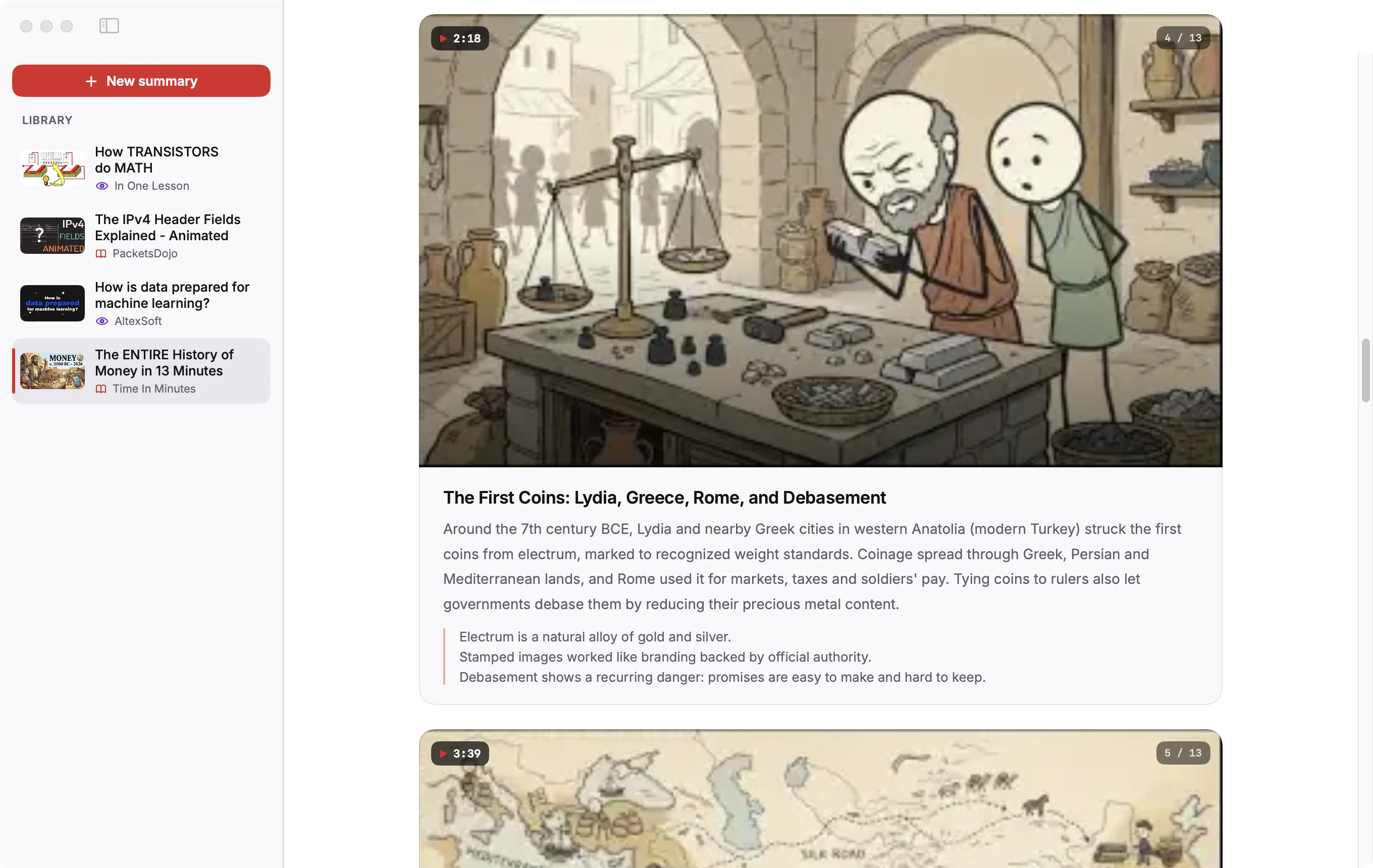
The First Coins: Lydia, Greece, Rome, and Debasement
Around the 7th century BCE, Lydia and nearby Greek cities in western Anatolia (modern Turkey) struck the first coins from electrum, marked to recognized weight standards. Coinage spread through Greek, Persian and Mediterranean lands, and Rome used it for markets, taxes and soldiers' pay. Tying coins to rulers also let governments debase them by reducing their precious metal content.
- Electrum is a natural alloy of gold and silver.
- Stamped images worked like branding backed by official authority.
- Debasement shows a recurring danger: promises are easy to make and hard to keep.
Chinese Coins and the Birth of Paper Money
Ancient Chinese states used bronze money shaped like tools, and later round coins with central holes that could be strung together. Because heavy strings of coins were awkward for large payments, privately issued Jiaozi notes appeared in Sichuan around the early 11th century, and the Song state later took over the system. Overissuing paper under the Yuan and Ming dynasties caused inflation and lost confidence.
- Paper's value came from institutions and expectations, not from the material itself.
- The lesson was not that paper money was doomed, but that it needs credible limits.
Merchant Credit, Bills of Exchange, and Ledger Banking
To avoid carrying silver across borders, merchants developed credit arrangements and exchange instruments in several traditions. By the late medieval period, European merchant bankers settled debts between cities with bills of exchange. Their deposit accounts allowed transfers to happen simply by changing entries in books.
- These practices developed gradually rather than being invented all at once.
- Money shifted from a physical thing toward a reliable record of who owned what.
European Banknotes, Central Banks, and Bank Runs
Stockholms Banco issued Europe's landmark banknotes in 1661 as a replacement for Sweden's huge copper plate money. It issued more notes than it could honor and failed. The Bank of England, founded in 1694, issued notes as governments came to rely on organized banking, while the risk of bank runs fueled debates about regulation and reserves.
- Debates covered reserve arrangements and lenders of last resort.
- A bank breaks if immediately payable claims exceed what it can pay out.
The Gold Standard and Its Limits
In the 19th century, industrial economies increasingly promised to convert currency into a fixed quantity of gold. That felt reassuring, but it limited how governments could respond to recessions and banking crises. It did not prevent credit shortages, unemployment or volatile prices.
- A stable-looking monetary rule is not the same as a stable economy.
Bretton Woods and the 1971 End of Gold Convertibility
In 1944, 44 countries met at Bretton Woods and linked their currencies to the US dollar, with the dollar convertible to gold for foreign monetary authorities. Eventually, foreign claims on US gold exceeded what the United States could redeem. In August 1971, Nixon suspended convertibility, and many currencies moved to market-determined exchange rates.
- The suspension ended an official international promise, not ordinary citizens trading dollars for gold.
Fiat Money, Inflation, and Purchasing Power
Most national currencies today are fiat money issued under public authority. Their value depends on the economy, policy, laws and continued acceptance. When prices rise faster than incomes, the same note buys less.
- Money is also a measure people use to plan their futures, not just a payment tool.
Charge Cards, Electronic Balances, and Bank-Created Money
Diners Club introduced a multi-purpose charge card in 1950, and bank-issued cards and card networks followed. Computers turned bank balances into electronic records, which are legal claims on a bank rather than stored cash. Commercial banks create new deposit money when they make loans, within regulatory limits.
- Electronic payments move instructions through institutions without moving physical cash.
- Most everyday money consists of promises inside the financial system.
Bitcoin, Blockchain, and the Double-Spending Problem
During the 2008 financial crisis, Satoshi Nakamoto proposed Bitcoin, a way to transfer digital value without a central operator. It prevents double-spending with a shared public ledger and proof of work, and its network launched in January 2009. It still requires trust and carries real risks.
- Digital files are easy to copy, which is a problem for independent money.
- Risks include volatility, theft, irreversible mistakes and energy use.
- Not every electronic payment needs a blockchain.
Conclusion: The Enduring Question of Trust
The video concludes that money's strangest feature is that people exchange real work and goods using an agreement no single object can guarantee forever. A Mesopotamian scribe, a Song merchant, a Swedish banker and a modern software engineer would all face the same question: will this promise be worth something tomorrow?
End of summary
Klaara writes a result like this for each video you paste, as long as it has captions.
Try it with your own videoVideos in the screenshots: The ENTIRE History of Money in 13 Minutes by Time In Minutes, The IPv4 Header Fields Explained - Animated by PacketsDojo, How TRANSISTORS do MATH by In One Lesson, How is data prepared for machine learning? by AltexSoft, licensed under CC BY. Thumbnails and frames are from those videos, scaled; the text is written by Klaara. The creators are not affiliated with Klaara and don't endorse it.
How it works
From a link to a summary in three steps
- 1
Paste a YouTube link
Klaara reads the video's captions, including the ones YouTube makes automatically.
- 2
Choose how you want it
Read it writes an article with chapters, frames and key points. Watch smarter puts the key moments beside the player.
- 3
Read it in a few minutes
The summary is usually ready in one to three minutes and stays in your library on your Mac.
Your first 3 summaries run on us. After that you buy Klaara once for €19 and add your own API key.
Features
Read the video, or watch it with the key moments beside it
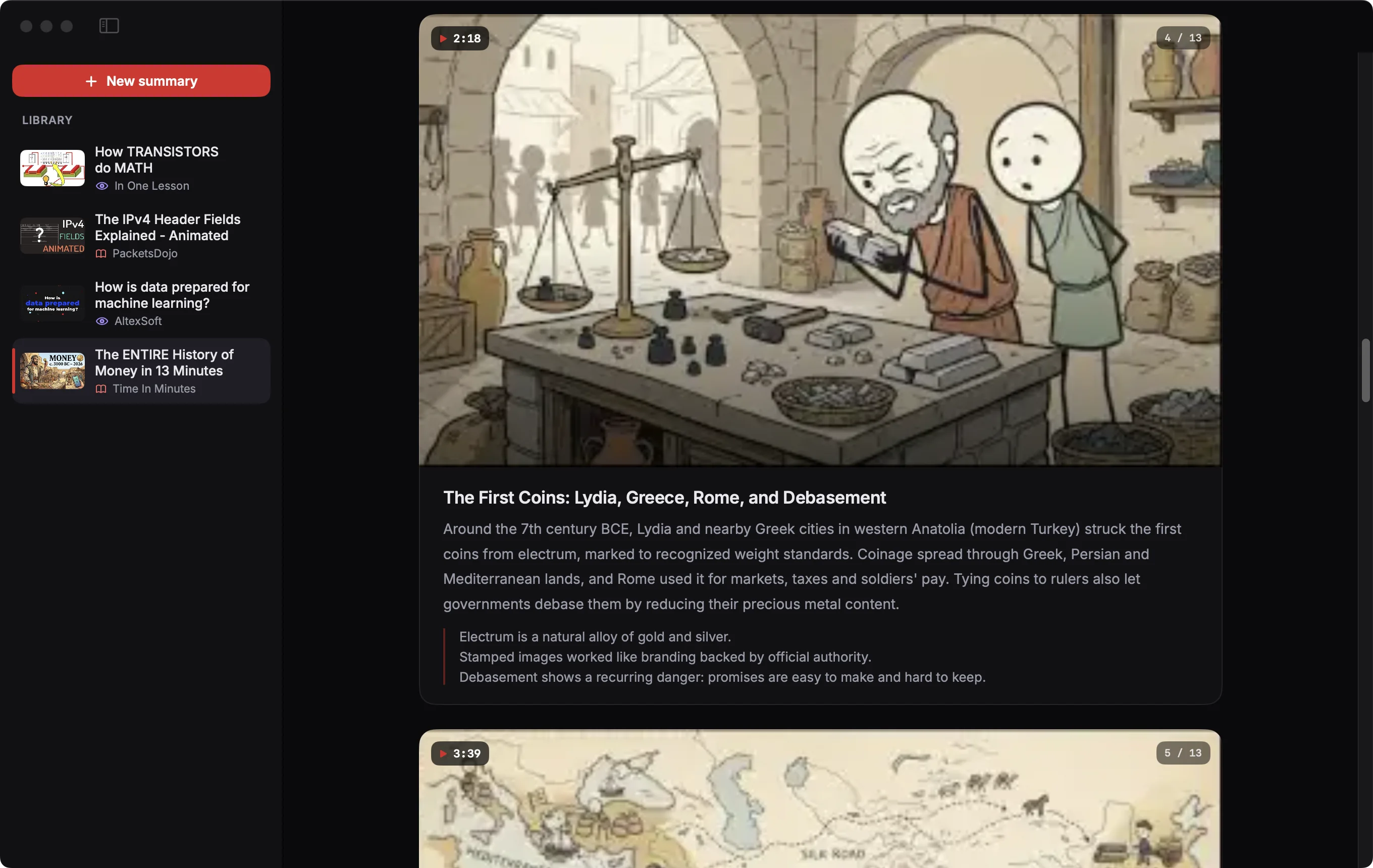
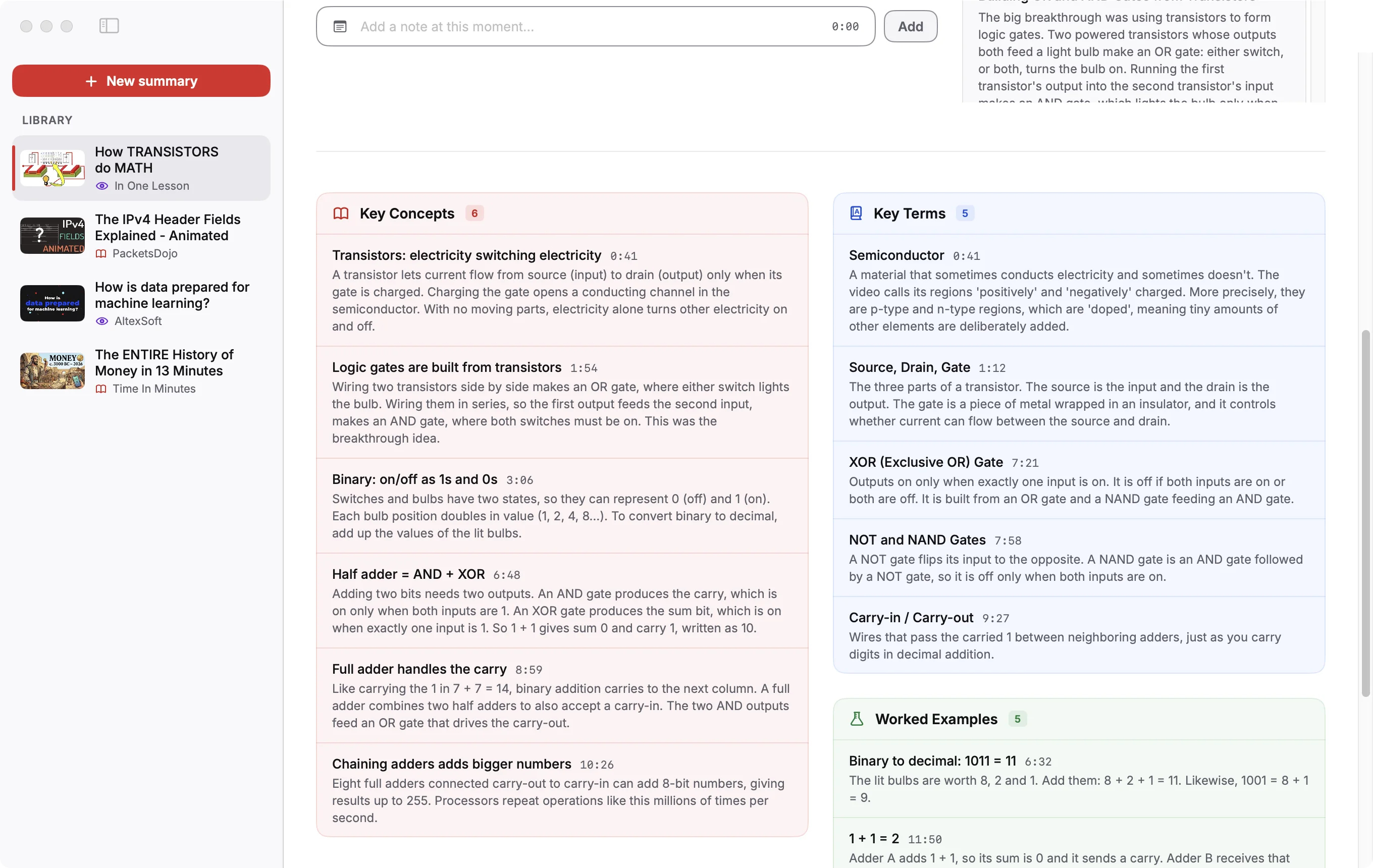
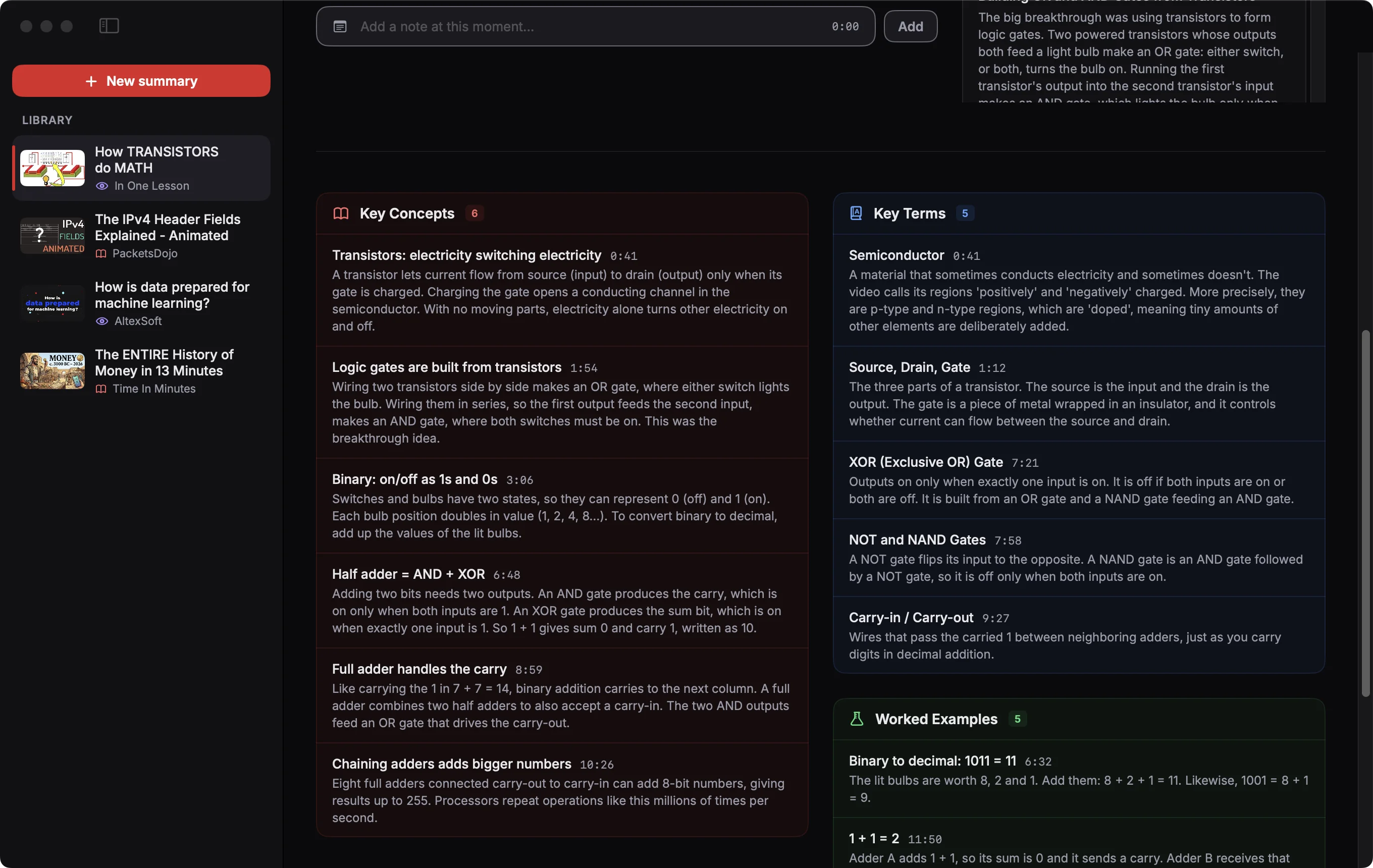
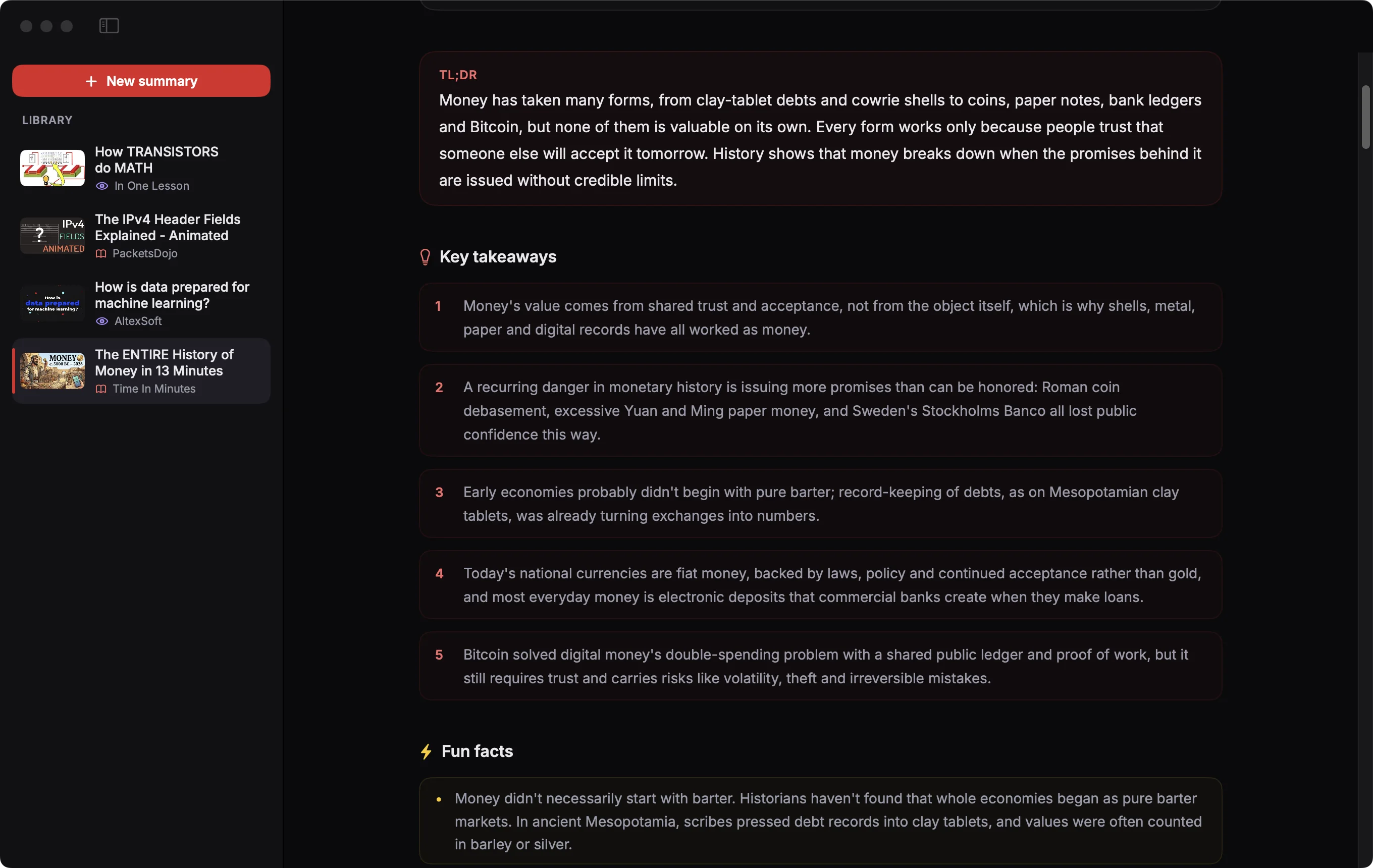
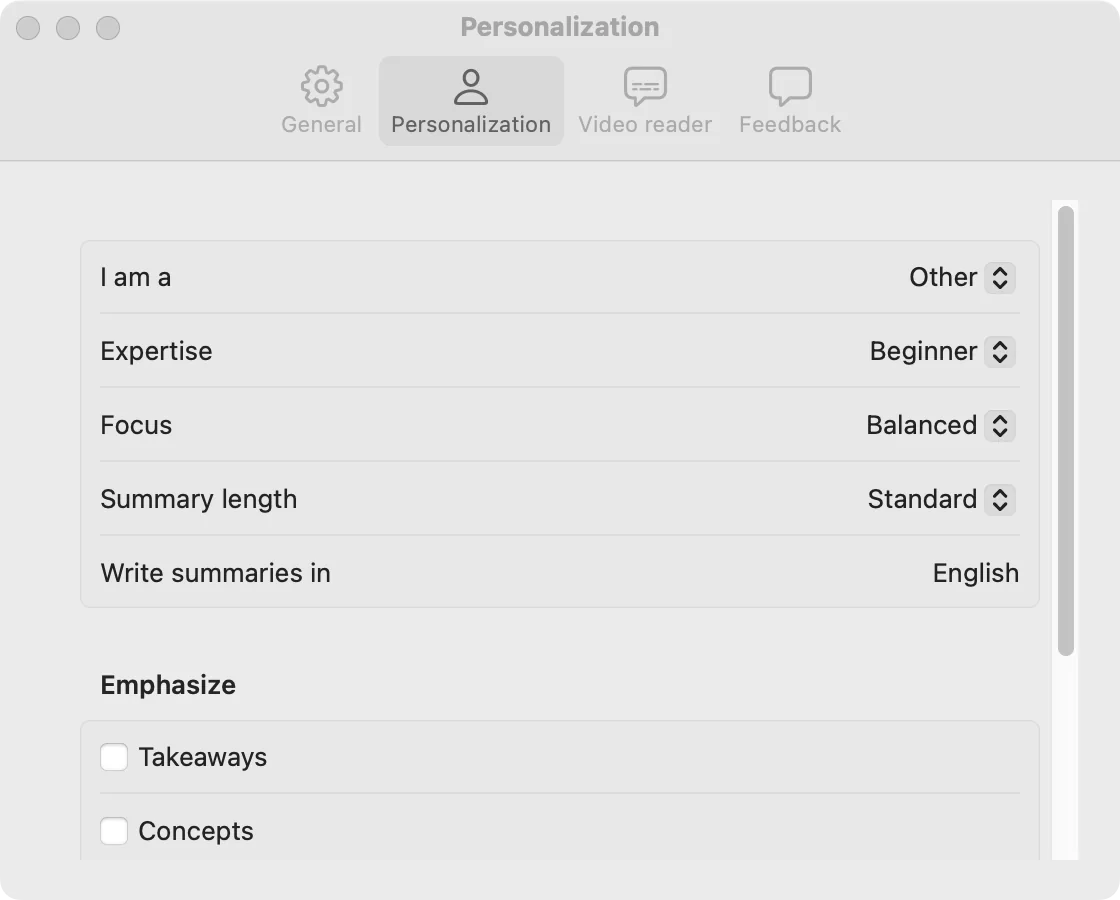
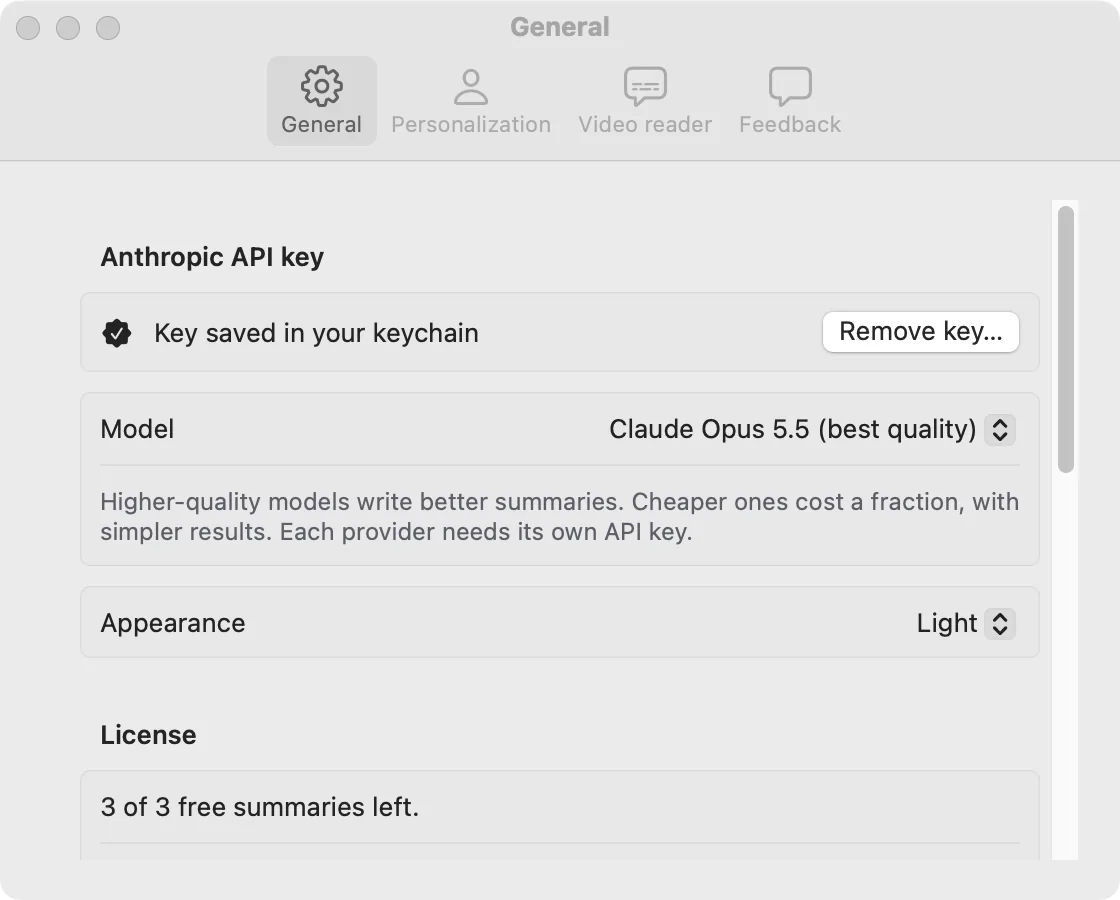
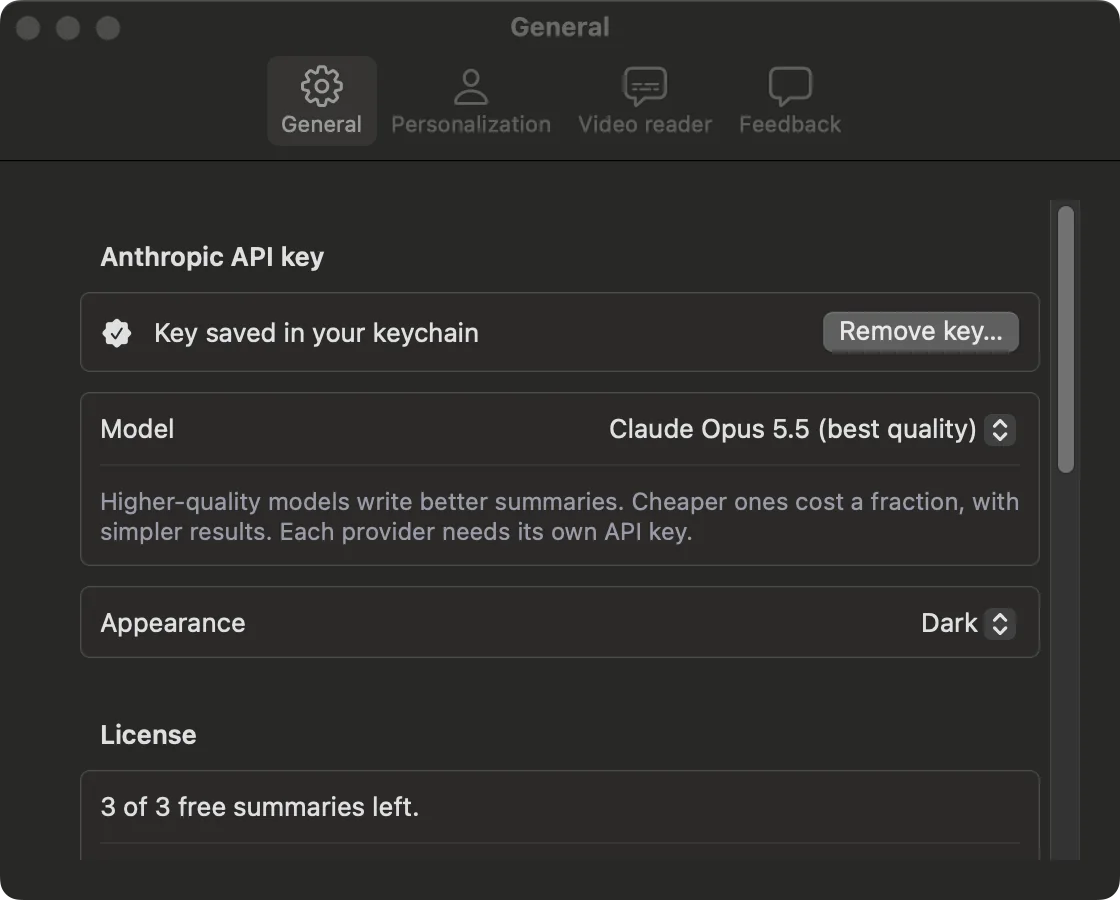
These are screenshots of the app on a Mac. Every summary is saved in your library, so you can read it again without paying twice or copy it into your notes as Markdown.
For Claude Code
Ask Claude Code about the videos you've summarized
Klaara comes with a read-only MCP server. After one command in Terminal, Claude Code can search the summaries, notes and transcripts in your library from any project and quote the timestamps.
claude mcp add --scope user klaara -- "/Applications/Klaara.app/Contents/MacOS/klaara-mcp"Then ask something like "What did that keynote say about portability? Quote the timestamps." The server needs no API key of its own and only reads what you've already summarized. Setup and real output
Pricing
You pay €19 once and keep the app
After your free summaries, your AI provider bills you directly for what you use, and Klaara adds nothing on top.
Klaara for Mac
Everything is included, with no plans and no subscription.
- All updates free
- Up to 3 Macs
- Read and Watch modes
- No Klaara account
Needs macOS 14 or later on Apple silicon. You add your own API key after the free summaries.
What you pay your AI provider
For a 20-minute video, at list prices on 5 November 2026.
| Model | 20-minute video | Based on |
|---|---|---|
| Claude Opus 5.5 | $0.25 to $0.34 | measured |
| Claude Sonnet 5.5 | $0.13 to $0.17 | recalculated |
| Claude Haiku 5.5 | Under 1 cent | recalculated |
Sonnet is the default. Measured means a real run on that model, and recalculated means we priced the tokens of our Opus runs at that model's price. Your cost depends on the video's length and the model you pick. All models, including ChatGPT, Grok and Gemini
Is Klaara for you?
There's no money-back offer, so please check this and try the free summaries before you buy.
It fits if
- You have a Mac with Apple silicon (M1 or newer) and macOS 14 or later.
- You'd rather read a long video than sit through all of it.
- You want to pay for the app once instead of a subscription.
It's not for you if
- You use an Intel Mac, Windows or only a phone. Klaara runs on Apple silicon Macs only.
- You don't want to pay for AI use after the free summaries. From then on each summary runs on your own key, starting at under 1 cent.
- Most of your videos have no captions. Klaara reads captions and can't summarize a video without them.
Frequently asked questions
Everything you need to know before you buy.
Do I need an API key?
Not for your first 3 summaries, which run on us. After you buy, you add a key from Anthropic, OpenAI, xAI or Google, and it stays in your Mac's Keychain. How to get a Claude key
Does my ChatGPT or Claude subscription work?
No. ChatGPT Plus and Claude Pro cover the chat apps and don't include API access. An API key is billed separately for what you use, and a 20-minute video costs from under 1 cent. Getting a key
What does each video cost?
It depends on the model and the video's length. A 20-minute video runs from under 1 cent to about $0.34. You pay your AI provider directly and Klaara adds nothing on top. The numbers
How long does a summary take?
Usually one to three minutes. In our test runs it took between half a minute for a short video and about two and a half minutes for a 54-minute interview.
Is there a subscription?
Not from Klaara. You pay €19 once and all updates are free. After your free summaries, your AI provider bills you for what you use.
Can I get a refund?
Klaara has no money-back offer, so please try the 3 free summaries before you buy. This doesn't affect your statutory rights.
What data leaves my Mac?
The video ID goes to YouTube to fetch captions, and the embedded player loads from YouTube. The transcript goes to the AI provider you chose, with your key. Your license key goes to Lemon Squeezy when you activate. The app also asks klaara.de once per launch whether a new version exists, which sends no account or usage data. Klaara runs no server that receives your summaries, and the app has no analytics.
Which videos work?
Videos with captions, including YouTube's automatic ones. A video with no captions can't be summarized.
What happens when YouTube changes something?
Klaara uses yt-dlp to read captions, and it updates that tool on its own when a video fails. You don't have to wait for an app update.
On how many Macs can I use it?
Up to 3. You can deactivate a Mac in Settings and move the license to another one.
Start reading instead of watching.
3 free summaries, no API key needed. Then €19 once, with all updates free.